Navigating the Biologic Patent Cliff: The Critical Role of Deep-Dive Biosimilar Patent Landscaping
The pharmaceutical landscape is undergoing a monumental shift. The era of small-molecule blockbusters is giving way to the dominance of biologics—complex, large-molecule drugs derived from living cells. These therapies, ranging from monoclonal antibodies to gene therapies, have revolutionized treatment for conditions like cancer, rheumatoid arthritis, and diabetes.
However, the immense success of these biologics comes with a significant challenge: the impending "patent cliff." As foundational patents for many top-selling biologics expire, the market is opening up for biosimilars—authorized, highly similar versions of the original biologic. For patent search companies and drug developers alike, this creates an environment that is both lucrative and incredibly complex.
Navigating this terrain requires more than just a cursory freedom-to-operate (FTO) search. It demands a sophisticated strategic tool: Deep-Dive Biosimilar Patent Landscaping.
This article explores why deep-dive landscaping is indispensable for biosimilar developers, the unique challenges of biologic IP, and the advanced methodologies required to execute an effective landscape.
The Biologic Patent Thicket: Complexity by Design
Unlike small-molecule drugs, which usually have a clear chemical structure protected by a handful of straightforward patents, biologics are inherently complex. They are produced in living systems (like bacteria or mammalian cells), making their exact structure difficult to define. This complexity is mirrored in their patent portfolios.
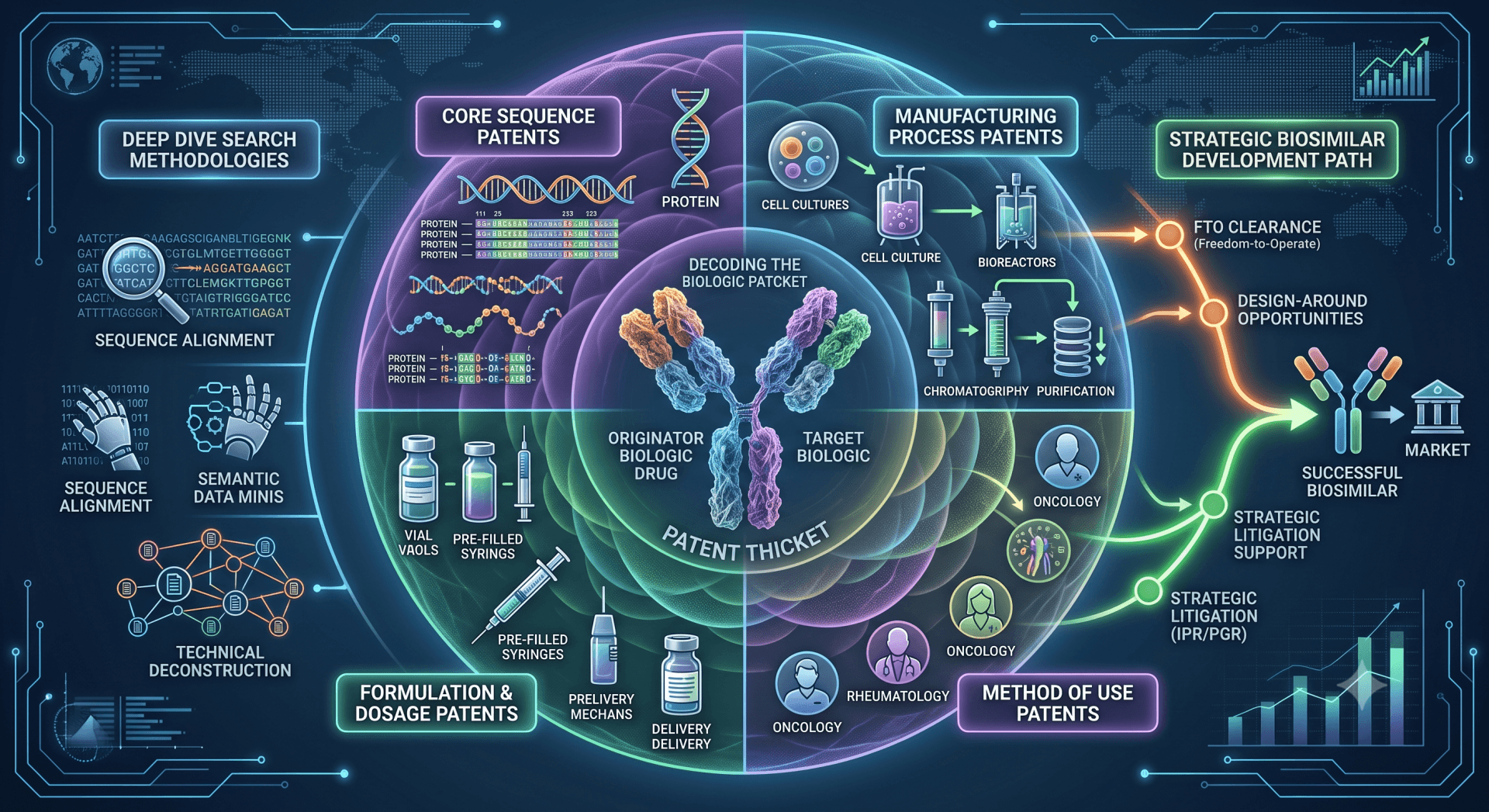
Originator companies (innovators) often construct formidable "patent thickets" around their blockbuster biologics. This strategic layering of IP aims to protect every conceivable aspect of the drug, far beyond the initial active ingredient. A typical biologic patent thicket includes:
- Core Composition of Matter Patents: These protect the original, foundational molecule or sequence (e.g., the monoclonal antibody itself). These are the first to expire.
- Manufacturing Process Patents: These cover the specific cell lines, expression systems, culture conditions (media, temperature), purification methods, and scale-up processes used to make the biologic. These patents are often the most challenging to navigate and can extend protection for years.
- Formulation Patents: These protect the specific recipe of excipients, buffers, and stabilizers used to deliver the drug (e.g., a specific concentration in a vial vs. a pre-filled syringe).
- Dosage and Administration Patents: These protect specific dosing schedules (e.g., once weekly vs. every two weeks) or methods of delivery.
- Method of Use Patents: These cover new therapeutic indications (e.g., using the same drug for a different type of cancer).
This thicket strategy, often termed "evergreening," creates a maze of overlapping patent claims that biosimilar developers must successfully navigate before commercial launch.
The Strategic Objectives of Biosimilar Patent Landscaping
A deep-dive patent landscape is not a check-the-box exercise. It is a comprehensive intelligence-gathering operation designed to support critical business and R&D decisions. The core objectives include:
- Risk Mitigation (Freedom-to-Operate): This is the most critical function. The landscape must identify every active patent that could potentially be infringed by the biosimilar. This requires analyzing the entire thicket, not just composition of matter patents.
- Defining Development Windows: By identifying the expiration dates of key patents in the thicket (especially manufacturing and formulation patents), developers can accurately determine when they can legally enter the market.
- Competitor Intelligence: A robust landscape maps out who owns which patents in the space. Is the originator the only player, or have competitors already carved out their own IP positions in formulation or manufacturing?
- Identifying Design-Around Opportunities: The thicket analysis reveals exactly what the originator is not protecting. This intelligence is crucial for R&D teams, enabling them to design manufacturing processes or formulations that steer clear of active patent claims.
- Strategic Litigation Support (IPR/PGR/Patent Dance): In jurisdictions like the U.S., the biosimilar approval pathway (the BPCIA) involves a structured exchange of patent information (the "Patent Dance"). A strong landscape provided early in development gives developers a significant advantage when preparing for or defending against litigation, such as filing Inter Partes Reviews (IPRs) to challenge the validity of blocking patents.
Advanced Search Methodologies: Cutting Through the Complexity
Executing a deep-dive landscape on a biologic thicket requires specialized expertise and advanced tools far beyond standard keyword searching.
1. Advanced Sequence Searching
For composition of matter and foundational claims, searching for nucleotide and protein sequences is essential. This requires specialized sequence databases (like CAS Registry, GenomeQuest, or WIPO PATENTSCOPE’s sequence search) and familiarity with various alignment algorithms (like BLAST). The search must account for modifications, variations, and partial sequences that might still fall under broad patent claims.
2. Deconstructing Product-by-Process Claims
Many biologic manufacturing patents rely on "product-by-process" claims, where the product is defined partly by how it is made. These claims are notoriously difficult to interpret and require a deep technical understanding of fermentation, cell culture engineering, and purification technologies to properly assess the likelihood of infringement.
3. Analyzing "Dormant" or Unpublished IP
Patent applications are generally published 18 months after filing. In the fast-moving world of biosimilars, this creates a significant "blind spot." Expert landscaping teams must utilize advanced monitoring strategies, including searching for related PCT (Patent Cooperation Treaty) applications or tracking parent applications, to anticipate emerging IP risks that may not yet be public knowledge.
4. Semantic and Functional Searching
Because biologics often involve highly technical or novel terminology, relying solely on keywords is insufficient. Patent searchers use semantic search tools (which understand the context and meaning of technical terms) and "functional searching" (searching for the function or mechanism of action rather than specific names).
The Patent Landscape as a Strategic Partner
For biosimilar developers, the difference between success and failure often hinges on the quality of their IP intelligence. Relying on superficial or outdated search data is a high-stakes gamble that can result in development halts, costly litigation, and significant market delays.
A deep-dive patent landscape is an investment in strategic foresight. It empowers developers to understand the full complexity of the innovator’s IP fortress, identify a clear development path, and optimize their R&D efforts. In the intensely competitive and litigious world of biologics, this deep intelligence is not a luxury—it is an absolute necessity.